



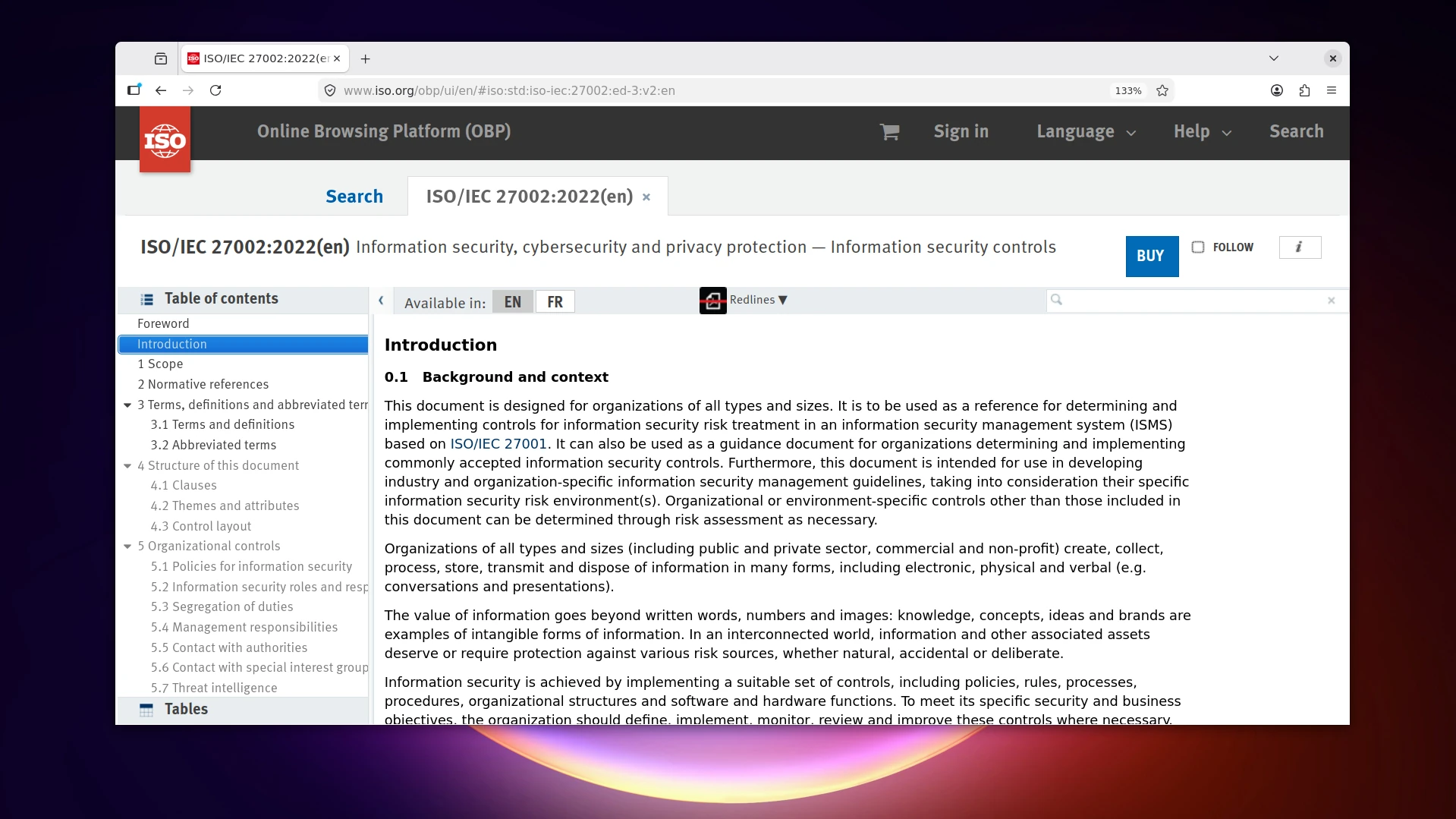
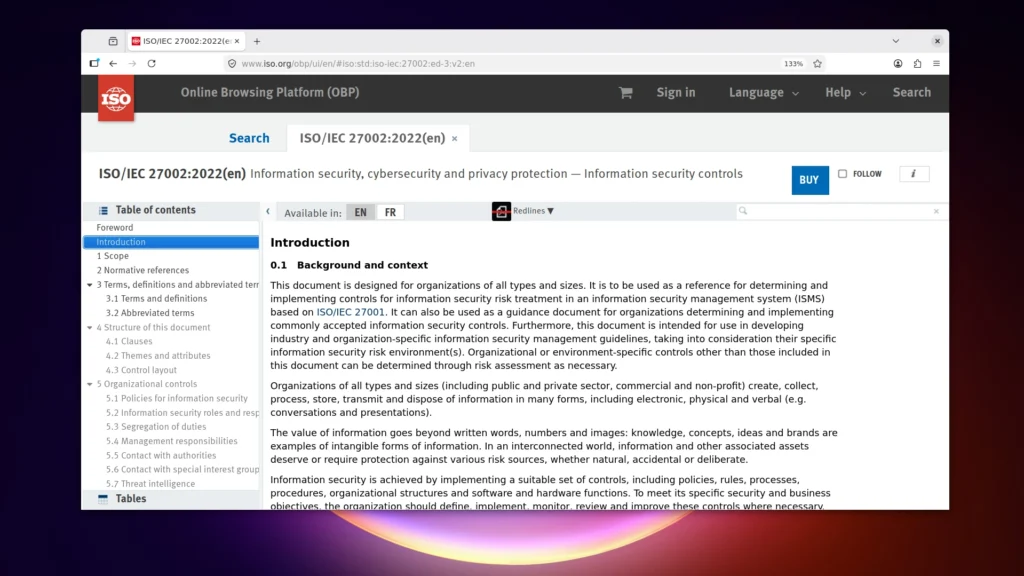
The international ISO/IEC 27002 standard is the core descriptive manual for any organization seeking digital maturity. Its value lies in enabling technology leaders to become familiar with and dive deeply into each control point, serving as the tactical foundation for developing the SoA (Statement of Applicability). Without ISO 27002’s detailed guidance, the ISO 27001 Statement of Applicability would be little more than an intention; with it, it becomes an executable and auditable roadmap.
1. Introduction: From Policy to Action
If ISO 27001 is the architectural blueprint of a building, ISO 27002:2022 is the engineering manual that specifies the materials, tolerances, and security systems. While ISO 27001 sets the requirements for a Management System, ISO 27002:2022 is the detailed control catalog that makes security actually happen. For comprehensive consulting, this standard is the tool that enables the transition from strategic planning to effective execution in the day-to-day operations of a company or government institution. We must understand that strategic planning is only effective if it translates into flawless operations. This standard provides international best practices so every technology decision is aligned with the mitigation of real risks.
2. The New Structure: Less Is More (and Better)
In the 2022 version, the standard was modernized to reflect the technological reality I experience as a software engineer and information security lead. Redundancy was removed, grouping controls into 4 logical categories that any executive can understand:
- Organizational (37 controls): How we define the rules of the game.
- People (8 controls): The human factor as the first line of defense.
- Physical (14 controls): Security of the tangible environment.
- Technological (34 controls): Protection of our systems, networks, and code.
3. The Value of “Attributes”: Security with Data Intelligence
The most innovative feature of ISO 27002 is that each control now has attributes. One of the strongest elements of the new version is precisely the introduction of control attributes. This allows leadership and technical teams to speak the same language through five key labels:
- Control Type: Are we preventing the attack, detecting it in real time, or correcting the damage? (Preventive, Detective, Corrective).
- Security Properties: Does this control protect privacy (Confidentiality), data accuracy (Integrity), or system uptime (Availability)?
- Cybersecurity Concepts: Full alignment with global frameworks such as NIST (Identify, Protect, Detect, Respond, Recover).
- Operational Capabilities: Classifies the control by practical function: network security, asset management, physical security, etc.
- Security Domains: Strategic classification for senior leadership.
Strategic value: These labels make compliance automation possible. We can generate control dashboards that show leadership, in real time, how well protected the organization is against specific threats.
4. Security in Software’s DNA (Control A.8.28)
As a developer with 20 years of experience, I highlight the emphasis the standard now places on security in the development lifecycle. This is no longer an optional appendix; it is a critical operational capability. Implementing ISO 27002 means the software we deliver to clients is not only functional, but resilient by design.
It is no longer enough to “test security” at the end of the project. ISO 27002 now requires:
- Environment separation: Development, testing, and production must be strictly isolated to prevent leaks of real data.
- Vulnerability management in code: Continuous audits and dependency scanning to prevent supply chain attacks (like those recently seen worldwide).
- Repository protection: Ensuring technical knowledge (source code) is protected against unauthorized access.
5. Threat Intelligence and Cloud Security (The New Controls)
To strengthen an organization’s security posture, ISO 27002 incorporated modern controls that were previously optional:
- Threat Intelligence (5.7): It is not enough to wait; organizations must collect information on attacks occurring in their sector to strengthen defenses before those attacks arrive.
- Cloud Services Security (5.23): Since most companies now operate in the cloud, this control defines how to manage shared responsibility with providers such as AWS, Azure, or Google Cloud.
- Data Leakage Prevention (DLP – 8.12): Tools and processes to ensure sensitive information does not leave the organization’s controlled boundaries.
6. Conclusion: The Manual for Operational Excellence
Adopting ISO 27002 is not about filling out a checklist; it is about professionalizing technical operations to eliminate improvisation. In complex environments, having an internationally proven tactical manual is what separates companies that survive from those that lead.
Tactical Maturity Checklist: How Close Is Your Operation to Excellence?
Based on the most critical controls in ISO/IEC 27002:2022, we designed this brief technical self-assessment. If your answer is “No” or “I’m not sure” in more than two areas, your organization may be operating under unnecessary risk.
- Threat Intelligence (Control 5.7): Do we receive and analyze information about current sector threats to proactively adjust our defenses?
- Identity and Access Management (Control 8.5): Do we have a Least Privilege model and Multi-Factor Authentication (MFA) implemented for all critical access points?
- Secure Development (Control 8.28): Does our code undergo automated security testing and vulnerability reviews before deployment to production?
- Cloud Security (Control 5.23): Do we have clear policies and technical configurations ensuring our cloud data (SaaS/PaaS/IaaS) is not accidentally exposed publicly?
- Data Leakage Prevention (Control 8.12): Do we have tools or processes capable of detecting and blocking unauthorized transfer of sensitive information outside the organization?
- Monitoring and Detection (Control 8.16): Do we continuously log and analyze unusual activity in our systems to detect intrusions before they cause damage?
The Next Step: From Self-Assessment to Certainty
Information security is not a product you buy; it is a capability you build. As we have seen, ISO 27002 provides the tactical map, but execution requires multidisciplinary teams that understand both source code and business strategy.
Addressing a Key Question: Why?
Beyond regulatory compliance and ISO 27002 technicalities, implementing these controls responds to a broader vision of organizational impact. In my trajectory as a developer and CISO, I have identified that the real purpose of this effort can be summarized in three pillars:
- To guarantee Continuity of Purpose: In complex and volatile environments, cybersecurity is the life-support system that ensures a technical incident does not become a reputational or financial crisis that halts a company or government mission.
- To democratize Trust: In the information era, trust is the most valuable currency. These controls allow clients, partners, and citizens to interact with your organization knowing their integrity is protected by international standards.
- To enable Innovation without Fear: When foundations are solid and risks are managed, the organization regains the freedom to experiment, scale, and deploy new technologies (such as AI, Cloud, or Web3) with confidence that growth is secure and sustainable.
Information security is not a destination; it is a capability you build. As we have seen, ISO 27002 provides the tactical map, but execution requires multidisciplinary teams that understand both source code and business strategy.
Comments